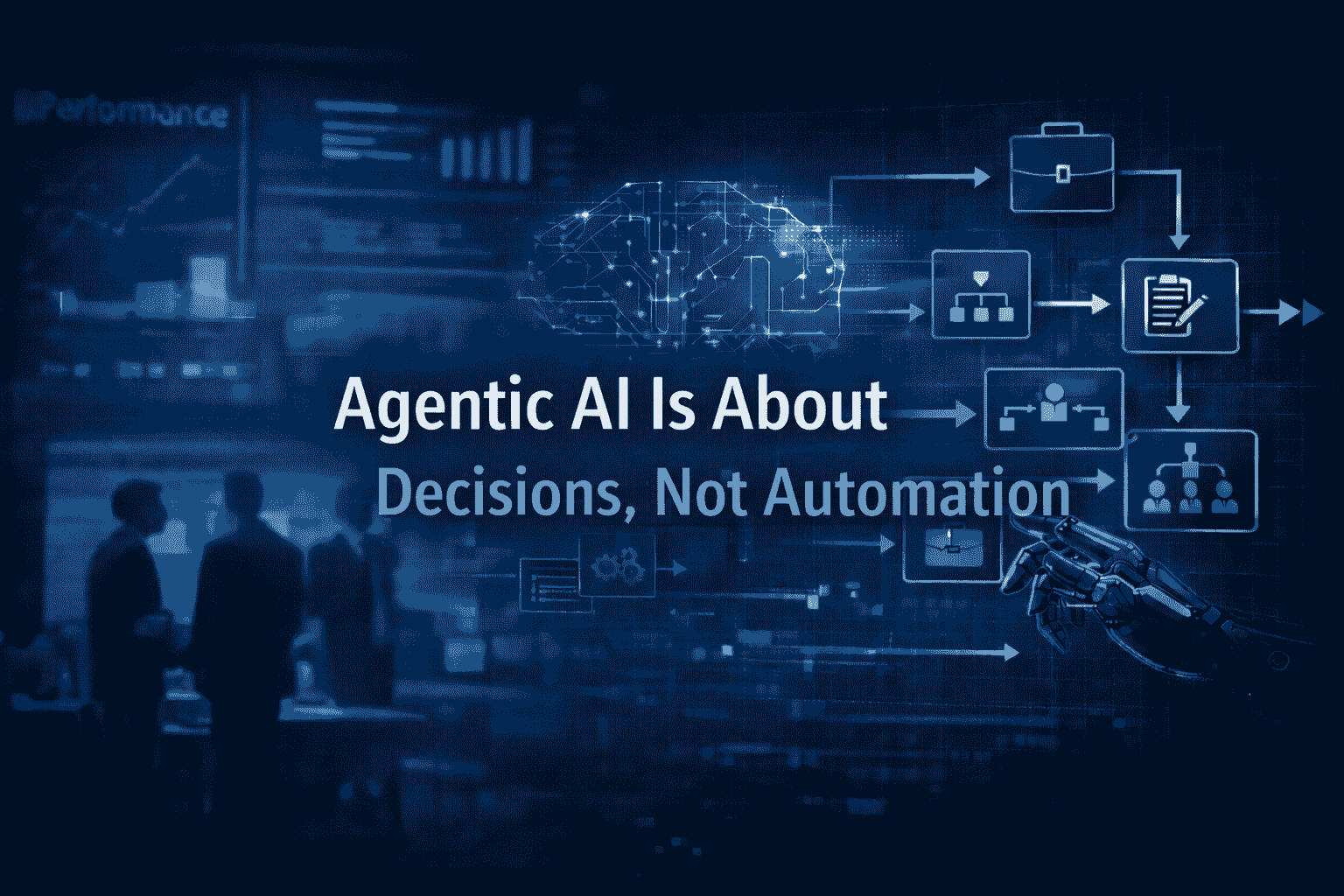
Agentic AI Is About Decisions, Not Automation
Context: The Business Situation
This case involves a mid-sized e-commerce marketplace operating across multiple regions.
Revenue was growing steadily. Customer acquisition was strong. Marketing performance was competitive. Yet margins were tightening and operational strain was increasing.
Internally, the business handled thousands of daily transactions. Pricing was reviewed manually. Inventory restocking relied on a mix of rules and spreadsheets. Marketing adjustments were made in weekly meetings based on dashboards that were already outdated by the time they were discussed.
Investors were asking about AI strategy. Competitors were announcing automation features. The board expected visible progress.
Peak season was approaching. If the company could not respond quickly to demand shifts and competitor pricing, profitability would erode despite revenue growth.
The risk was not lack of data. It was slow operational response.
The Problem as Leadership Saw It
Leadership interpreted the strain as excessive manual work.
Support teams were handling repetitive tickets. Analysts were producing weekly reports. Category managers were reviewing pricing line by line. Procurement teams were manually approving restock orders.
The metrics supported the narrative:
- Customer response times had increased.
- Stockout rates had risen by nearly 18%.
- Pricing adjustments lagged competitors by several days.
- Marketing ROI fluctuated unpredictably week to week.
The conclusion seemed logical: automate more.
If repetitive work could be reduced, teams would move faster. Efficiency would increase. Costs might fall.
The discussion centered on tools that could draft replies, generate summaries, and produce predictive dashboards.
The framing was about activity.
The Decisions on the Table
Three strategic directions were debated.
First, automate high-volume operational tasks to reduce workload.
Second, deploy predictive models to suggest pricing and inventory decisions while keeping final approval with managers.
Third, design agentic systems capable of executing certain decisions autonomously within defined boundaries.
The first option felt safe and visible. It promised immediate efficiency gains.
The second felt analytical and controlled. It improved insight without relinquishing authority.
The third felt conceptually powerful but operationally risky.
Board members leaned toward visible automation wins. Operational leaders preferred predictive tools with human review. The idea of systems making decisions raised concerns about governance and accountability.
The core framing, however, remained unchanged: AI as a productivity enhancer.
What Was Actually Going Wrong
Initial automation efforts were implemented.
Support responses were partially automated. Reporting was streamlined. Predictive dashboards improved forecast visibility.
Efficiency improved modestly.
But pricing still lagged.
Stockouts persisted.
Campaign adjustments remained reactive.
Meetings became slightly shorter, but decision cycles did not accelerate meaningfully.
The real bottleneck was not manual effort. It was decision latency.
Every meaningful change required interpretation, discussion, and approval. Even when data was available instantly, authority remained centralized.
The earlier assumption had been that value leakage came from manual tasks.
In reality, value leakage came from slow decisions.
They were not choosing the wrong AI tools.
They were solving the wrong problem.
How the Problem Was Reframed
The reframing question was direct:
“Where are we comfortable allowing the system to decide, within clearly defined guardrails?”
Instead of focusing on automation, the team examined decision patterns.
Which decisions were:
- Frequent
- Data-driven
- Bounded in risk
- Measurable in outcome
Three areas emerged:
- Dynamic pricing adjustments within a predefined percentage band.
- Inventory reordering within specified risk thresholds.
- Real-time marketing budget reallocation within daily limits.
This required governance clarity before technical implementation.
Risk tolerances had to be agreed upon.
Escalation rules needed to be explicit.
Performance thresholds for human intervention had to be defined.
The system was not instructed to optimize everything.
It was authorized to operate within limits set by leadership.
Human roles shifted from approving each action to supervising decision quality and adjusting boundaries when necessary.
Technology executed within the structure leadership designed.
The Outcome
Within two quarters:
- Pricing response time moved from days to minutes.
- Stockout rates reduced by approximately 12–15%.
- Marketing ROI variability stabilized.
- Weekly operational meetings shortened by nearly 40%.
Headcount did not materially decline. That was not the objective.
What changed was throughput.
Decisions that once required coordination across teams were now executed automatically within defined limits. Human attention moved upward to strategic exceptions rather than routine approvals.
The second-order effects were notable.
Managers focused on refining guardrails rather than debating micro-adjustments.
Cross-functional tension reduced because escalation logic was clear.
Leadership discussions shifted from operational firefighting to boundary design.
The measurable impact was meaningful. The structural shift was more important.
Key Learnings
For Founders
AI creates leverage not by replacing work, but by accelerating safe decision execution. The leverage lies in velocity, not novelty.
For HR Leaders
As bounded decisions are delegated to systems, roles evolve. The skill set shifts from execution to supervision and judgment.
For CTOs
Agentic AI is primarily a governance design challenge. Clear guardrails determine whether autonomy creates value or risk.
For Senior Operators
Not every decision should be automated. But recurring, bounded decisions should not require meetings.
Automation reduces effort.
Delegated decision authority reduces latency.
In fast-moving businesses, latency is often the hidden cost constraining growth.
I share shorter decision-level insights from this case on LinkedIn, focusing on specific moments and lessons.