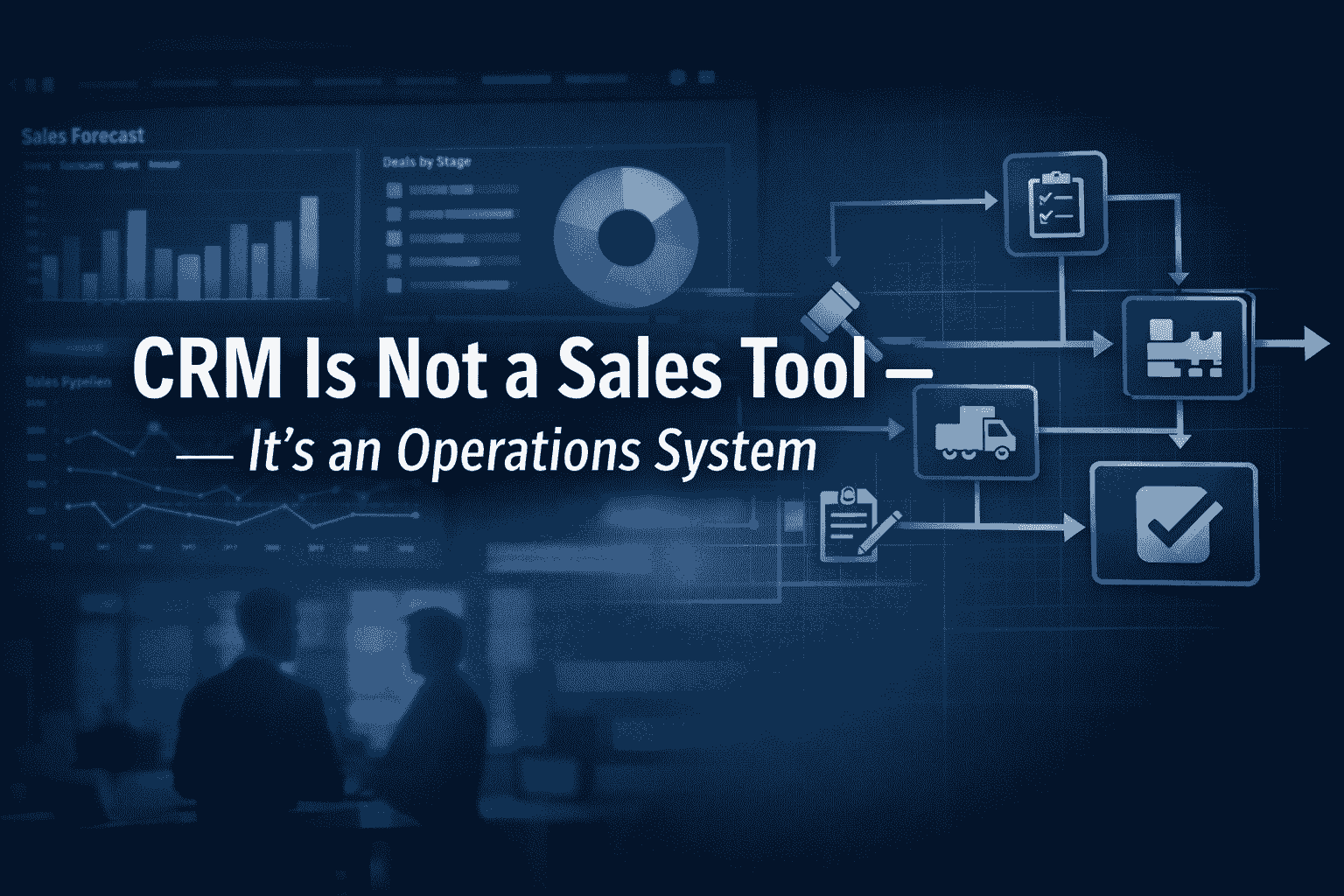
CRM Is Not a Sales Tool — It’s an Operations System
Context: The Business Situation
A mid-sized B2B services company, approximately 120 employees and ₹40+ crore in annual revenue, was in a growth phase. Sales headcount had doubled within nine months. Lead flow was strong. Enterprise conversations were increasing.
From the outside, momentum looked healthy.
Internally, pressure was building. Forecasts were frequently inaccurate. Onboarding timelines slipped. Finance struggled to reconcile projected revenue with actual cash flow. Operations felt sales was overcommitting. Sales felt operations was slowing deals down.
The company was preparing for investor discussions and geographic expansion. At that stage, unpredictability becomes more dangerous than slow growth.
The leadership team needed clarity — not just more activity.
The Problem as Leadership Saw It
Leadership believed the issue was sales discipline.
CRM updates were inconsistent. Deal stages were interpreted differently by different managers. Forecast accuracy hovered around 60–65%. Deals appeared strong in pipeline reports but failed to materialize on schedule.
The CRO pushed for tighter enforcement. The CEO wanted better visibility. The CTO suggested upgrading the CRM platform.
All of these reactions were rational. The data was unreliable. The pipeline looked inflated. The reporting layer felt weak.
At this stage, the working assumption was straightforward:
If CRM usage improves, predictability will improve.
The urgency was real. The diagnosis was incomplete.
The Decisions on the Table
Three primary options were discussed.
First, upgrade the CRM to a more advanced platform with stronger automation and reporting. This would signal modernization and potentially improve adoption.
Second, enforce stricter discipline. Mandatory updates, tighter review cycles, and consequences for non-compliance.
Third, hire a dedicated Sales Operations manager to “clean” the pipeline and ensure data hygiene.
Each option felt reasonable.
They were optimizing for speed, control, and clarity. From the outside, it looked like a systems issue. So they treated it as one.
The company moved forward with a CRM upgrade and strengthened reporting structures.
Dashboards improved. Activity tracking improved.
Revenue volatility did not.
What Was Actually Going Wrong
The problem was not CRM adoption.
It was structural misalignment between sales stages and operational reality.
Deal stages such as “Proposal Sent” or “Negotiation” had no internal meaning beyond conversation progress. A deal could move forward without pricing approval, legal alignment, delivery capacity confirmation, or onboarding bandwidth being considered.
The CRM was recording momentum. It was not enforcing commitment.
This created a dangerous illusion.
Sales saw probability.
Finance saw projection.
Operations saw risk.
Because the stages were not tied to operational triggers, the CRM was functioning as a reporting diary rather than an operating system.
The leadership team was trying to fix visibility. The deeper issue was decision integrity.
The same flawed assumption sat underneath every initial solution:
CRM is a sales tracking tool.
In reality, at scale, CRM becomes an operational coordination system.
How the Problem Was Reframed
The turning point came with a different question:
Which executive decisions depend on this data being accurate?
The answers were immediate. Hiring plans. Cash flow forecasting. Delivery capacity allocation. Incentive payouts. Investor reporting.
This shifted the conversation.
Instead of asking how to improve CRM usage, the focus moved to aligning CRM stages with operational commitment.
Deal stages were redefined. A stage advancement required internal conditions to be met — pricing framework confirmed, legal template aligned, delivery capacity provisionally allocated.
This reduced flexibility for sales teams in the short term. Some perceived it as friction.
But it increased system integrity.
Importantly, no heavy automation or complex customization was added. The goal was not technical sophistication. It was definitional clarity.
Technology was used conservatively. Architecture was simplified.
The trade-off was intentional:
Less superficial speed, more structural predictability.
The Outcome
Within six months, forecast accuracy improved from roughly 60–65% to the 80–85% range.
Average onboarding delays dropped from approximately 18–25 days to 7–10 days.
Quarterly revenue variability narrowed significantly.
More importantly, internal friction reduced.
Operations could plan capacity with greater confidence. Finance trusted projections. Sales conversations with leadership became less defensive and more strategic.
The CRM had not become more complex. It had become more truthful.
The improvement did not come from better dashboards. It came from better alignment between system design and business decisions.
Key Learnings
- CRM maturity is not about features. It is about whether system stages reflect operational commitment.
- If departments argue frequently about forecasts, the issue is often structural, not behavioral.
- Growth amplifies misalignment. What works at ₹10 crore breaks at ₹40 crore.
- Before upgrading tools, ask which executive decisions depend on their accuracy. That question often reframes the entire problem.
- Predictability is a design outcome, not a reporting outcome.
CRM, when treated correctly, is not a sales productivity tool. It is the spine that connects revenue intent with operational reality.
I share shorter decision-level insights from this case on LinkedIn, focusing on specific moments and lessons.